Meteor showers
Shooting stars are fiery rocks that leave a luminous trail across the sky as they plunge through our atmosphere. Here you can learn more about what they are, when and where to see them, and what is the difference between a meteor and a meteorite.
Shooting stars, also known as meteors, are small pieces of rock from space travelling towards Earth at very high speed. When the rocks enter our atmosphere, both they and the air around them become extremely hot. The glowing trail you see in the sky is therefore pieces of rock and air that have become so hot they begin to glow. The appearance of the shooting star depends on its size and how fast it is moving. Faint shooting stars, the most common kind, are normally seen as a small glowing streak that quickly disappears. They last a fraction of a second and are white in colour.
Large shooting stars, so-called fireballs, are more often seen as a bright object with a tail of glowing dust. Powerful meteors can also break apart into several pieces, almost like a firework rocket. They can last several seconds and their colour can be white, blue-white, greenish, yellow, or orange. If you have seen a fireball, you can register your observation here.
Note on Terminology
What is the difference between a shooting star, meteor, meteoroid, meteorite? It can be hard to keep track of what each term means. The interesting fact is that they are all the same object, just in different locations!
Meteoroids is the term used when the object is still out in space. It can be a larger or a smaller rock, or even dust grains, normally less than 10 metres in diameter. When rocks are larger than 10 metres, we call them asteroids, though in reality they are the same thing at different sizes. Another category of space rock is comets, which scientists often describe as “dirty snowballs”, a term that captures quite well what they actually are: giant balls of ice, frozen gases, and dust, left over from the formation of our Solar System. Meteoroids are formed when asteroids or comets collide and smaller pieces are knocked off.
Meteors, or shooting stars, is the term used when an object from space is travelling through Earth's atmosphere and leaving a glowing trail. Larger meteors are called fireballs. Meteorites is the term used when the object, if it has not burned up on its way through the atmosphere, has landed on Earth. We have found many meteorites on Earth, and they can help us learn about the history of the Solar System.

From left to right: a comet drifting through space with its characteristic tail, an asteroid, a meteoroid entering Earth's atmosphere, a meteor (also called a shooting star or fireball) blazing through the sky, and finally a meteorite, the fragment that survives the journey through the atmosphere and reaches the ground. (Credit: Canadian Space Agency)
Meteor Showers
Throughout the year there are special periods when you can see a great many shooting stars. These are called meteor showers and occur when Earth, on its orbit around the Sun, passes through the trail left by a comet or asteroid. As a comet or asteroid moves along its orbit, it leaves behind smaller debris and fragments. These are what become meteors when we cross the trail. As it takes Earth one year to orbit the Sun, we also pass through the asteroid trails at exactly one year intervals.
During a meteor shower, the shooting stars appear to come from a specific point in the sky. We say that they radiate from a particular point, which is where the asteroid's trail intersects with Earth's atmosphere.
Because the meteors always radiate from the same point, meteor showers are named after the constellations that lie behind the point they radiate from. For example, the Leonids and the Perseids are named after Leo and Perseus respectively.
Annual Meteor Showers
Shooting stars can be seen throughout the year, but are most likely to be spotted during one of the year's major meteor showers.
Quadrantids - January
The Quadrantids are a large but very short-lived meteor shower, normally peaking around January 3-4. Up to 120 shooting stars per hour can be seen at peak, along with many fireballs. The peak window is very short however, only around 6 hours, and bad weather is therefore often a limiting factor. The Quadrantids radiate from a point near the Big Dipper, and the meteoroids originate from the asteroid 2003 EH1.
Lyrids - April
The Lyrids are a medium-sized meteor shower in the second half of April, peaking around April 22nd-23rd. Around 10-20 shooting stars per hour can be expected at peak, many of which will leave faint trails, though fireballs are possible. The Lyrids radiate from the constellation Lyra, and the meteoroids originate from Comet Thatcher. It is one of the oldest meteor showers we know of, having been observed for 2,700 years.
Capricornids - July and August
The Capricornids are not normally a meteor shower we pay particular attention to in Denmark, but it is in fact active from mid-July to mid-August. The shower rarely produces large numbers of shooting stars, but it does produce many fireballs. The Capricornids radiate from the constellation Capricornus, and the meteoroids originate from Comet 169P/NEAT.
Delta Aquariids - July and August
The Delta Aquariids are a medium-sized meteor shower, active from mid-July to the end of August with a peak in late July. Up to 20 shooting stars per hour can be seen at peak. Unfortunately the Delta Aquariids are best seen from the southern hemisphere. They radiate from the constellation Aquarius, though shooting stars can be seen across the whole sky. The meteoroids originate from a group of comets and asteroids including the Marsden and Kracht comet groups and the asteroid 2003 EH1.
Perseids - July and August
The Perseids are one of the year's largest meteor showers, active from mid-July to the end of August, with a peak around August 12-13. Up to 100 shooting stars per hour can be seen at peak, and the Perseids are known for producing a particularly large number of big meteors and fireballs. The Perseids radiate from the constellation Perseus, but can be seen across the whole sky. The meteoroids are the remains of Comet Swift-Tuttle, which was last visible in the sky in 1992.
Draconids - October
The Draconids are a relatively small shower, active from October 6-10. Up to 10 shooting stars per hour can be seen at peak. The Draconids originate from the constellation Draco. The meteoroids come from Comet Giacobini-Zinner.
Orionids - October and November
The Orionids are one of the year's medium-sized meteor showers, active from early October to mid-November with a peak around October 22-23. The number of shooting stars varies from year to year, but around 10 per hour at peak. The Orionids are known for their brightness and speed, and the shooting stars can remain visible in the sky for several seconds. The Orionids radiate from the constellation Orion, and the meteoroids originate from Halley's Comet, which takes around 76 years to complete one orbit of the Sun.
Taurids - September to November
The Taurids are one of the smaller annual meteor showers, active from September to November with a peak in early November. Around 5 meteors per hour are expected at peak. The Taurids typically move slowly across the sky and large shooting stars, fireballs, can occur. The Taurids radiate from the constellation Taurus but can be seen across the whole sky, and the meteoroids originate from Comet Encke.
Leonids - November
The Leonids are a smaller meteor shower active throughout November with a peak around November 16-17. Around 15 shooting stars per hour can typically be seen at peak. The Leonids are known for producing fireballs and shooting stars with a blue and green tinge. The Leonids radiate from the constellation Leo and the meteoroids originate from Comet Tempel-Tuttle. Tempel-Tuttle visits the inner Solar System every 33 years, and when it does, the Leonids transform into a meteor storm that can produce more than a thousand shooting stars per hour. This will happen next in 2031-2032.
Geminids - December
The Geminids are one of the year's largest meteor showers, active in December with a peak around December 13-14. Up to 120 shooting stars per hour can be expected at peak. The Geminids radiate from the constellation Gemini, and the meteoroids are created from debris left by the asteroid 3200 Phaethon.
Ursids - December
The Ursids are one of the smaller meteor showers, active in late December with a peak on December 22. At peak, up to 10 shooting stars per hour can be expected. The Ursids radiate from the constellation Ursa Minor (the Little Dipper), and the meteoroids come from Comet 8P/Tuttle.
Observation Tips
Get out of the city and find a dark location where light pollution is minimal. You can find a list of dark locations in Denmark in the section The Night Sky - What You Can See. Dress warmly and bring a blanket. Watching for shooting stars requires patience, especially during some of the smaller showers where meteors can be few and far between. Check the weather forecast. If it is overcast, the chance of seeing shooting stars is zero. Also check when the Moon rises and sets. More shooting stars can be seen when the Moon is not in the sky. Look up! If you lie on your back, you have a larger portion of the sky in your field of view, and therefore a better chance of spotting a shooting star. Meteors can generally be seen across the whole sky, even though they appear on average to radiate from a specific point.

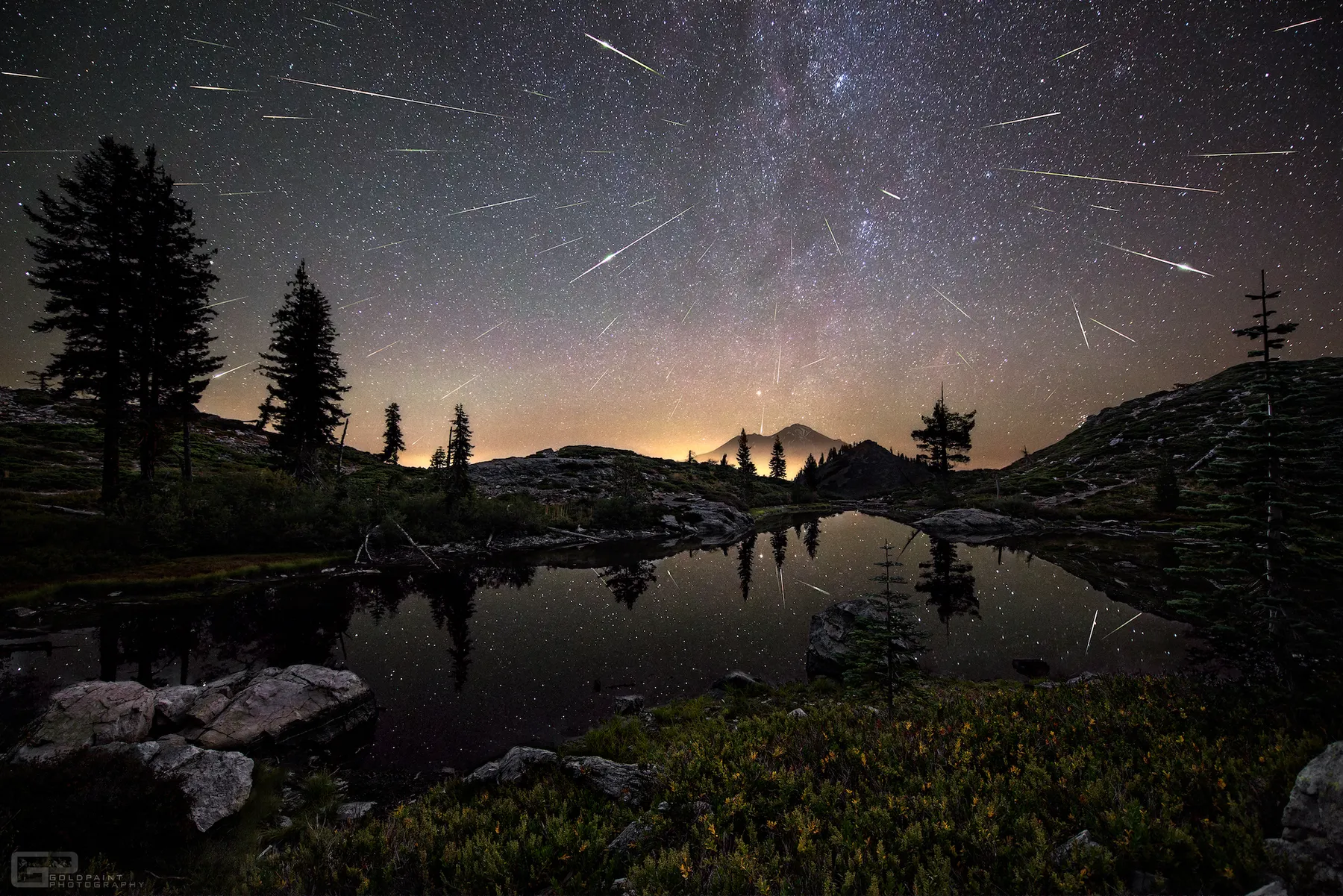
Image of the Perseids meteor shower. Notice how all the shooting stars appear to radiate from a single point in the sky.
Mythology
You may have experienced watching a shooting star streak across the night sky, and noticed that when the glowing trail fades, the night sky seems to hold an almost magical quality.
That feeling of magic has certainly been shared by many civilizations throughout history, with the result of generating countless legends and myths surrounding shooting stars. The sky has always been associated with the realm of the gods, both in ancient religions and those we know today, and shooting stars have often symbolized messages from the gods. However, whether these were good or bad omens, was not something everyone agreed on.
Many see shooting stars as a good omen: some Native American tribes believed that all life came down from the sky on shooting stars. Some Aboriginal Australian tribes believed that when a person dies, their soul travels by canoe to the world of the gods in the sky, and once they had arrived safely, they would send the canoe back as a shooting star, so that the family could see that all was well! Many have also believed that shooting stars were simply a small greeting from the angels in heaven.
Some, however, also see shooting stars as a bad omen of the gods' wrath! Certain Native American tribes see them as a sign that sickness and death are on their way, and in Siberia people were once certain that shooting stars were bloodsucking fire worms streaking across the sky! According to one old German folk tradition, shooting stars were a good sign that the entire coming year would be prosperous, unless, that is, you saw three shooting stars in one night, in which case it was a sign of certain death.
Today most people probably see shooting stars as something positive and lucky, and many believe that you get a wish when you see one. This tradition actually also comes from a Greek myth which says that shooting stars appear when the gods, sitting up in the heavens, become curious about the lives of humans and peek down between the stars. When they do, they sometimes accidentally nudge a star, sending it falling down as a shooting star! The shooting star thus became a sign that the gods are paying attention right now, and it therefore makes perfect sense to make a wish while they were paying attention to the life of mortals!
Shooting stars have probably always been seen as something significant, whether as bringers of luck and life or as omens of misfortune. We at the Planetarium also see shooting stars as something magical, but mostly because they remind us of how vast and wonderful space is, and how many amazing things are out there.