Auroras
The auroras are without doubt among the most fascinating and spectacular natural phenomena we can experience here on Earth. What are they, and how can we observe them?
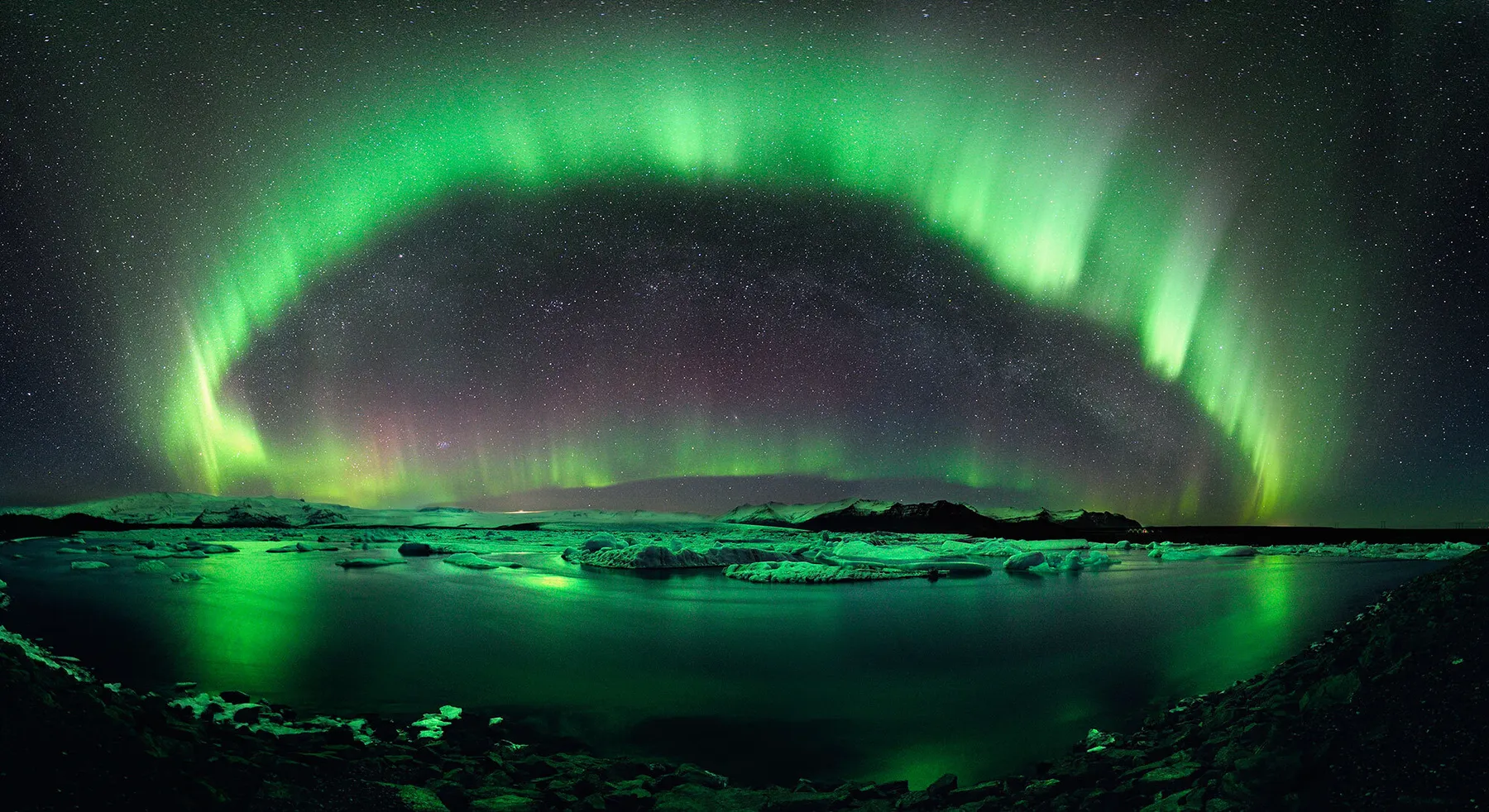
In Norse mythology, the beautiful patterns of colour in the sky were explained as a fence built by the gods to keep the giants out of Midgard, the world of humans. The fence was built from the eyelashes of the dead primordial giant Ymir. Today we know that the auroras (aurora borealis or northern lights and aurora australis or southern lights) occur when electrically charged particles from the Sun hit Earth's magnetic field. The particles are carried by the magnetic field towards Earth's north and south poles, where the air in that part of our atmosphere begins to glow, creating a spectacular light show. It can almost seem as though the auroras are close enough to touch, but in fact they occur 90 to 500 km above the surface!
Atmosphere Glows
You might think it is the particles from the Sun that light up when you see the auroras, but that is not actually how it works. It is the molecules in the atmosphere that glow. When they are struck by the electrically charged particles from the Sun, they enter what is called a higher energy state. Think of it like giving the molecule a little push of extra energy. But molecules cannot hold onto that extra energy for long, and quickly fall back to their original state. When they do, they release that energy as light, and that light is what we see as the auroras.
The colour of the auroras depends on which gas is being excited and at what altitude, creating a layered display that is essentially a map of Earth's chemistry. Green is the most common colour, produced by oxygen in the middle atmosphere at up to around 240 km altitude. Above that, where oxygen is much sparser, extreme solar activity can produce the rarest and most dramatic colour of all: red. Meanwhile, at lower altitudes, nitrogen takes over, producing the vivid purples and blues that often shimmer along the bottom edge of the display. On the most spectacular nights, all these layers appear at once, with red at the top, green in the middle, and purple and blue at the base.
Solar wind and solar eruptions
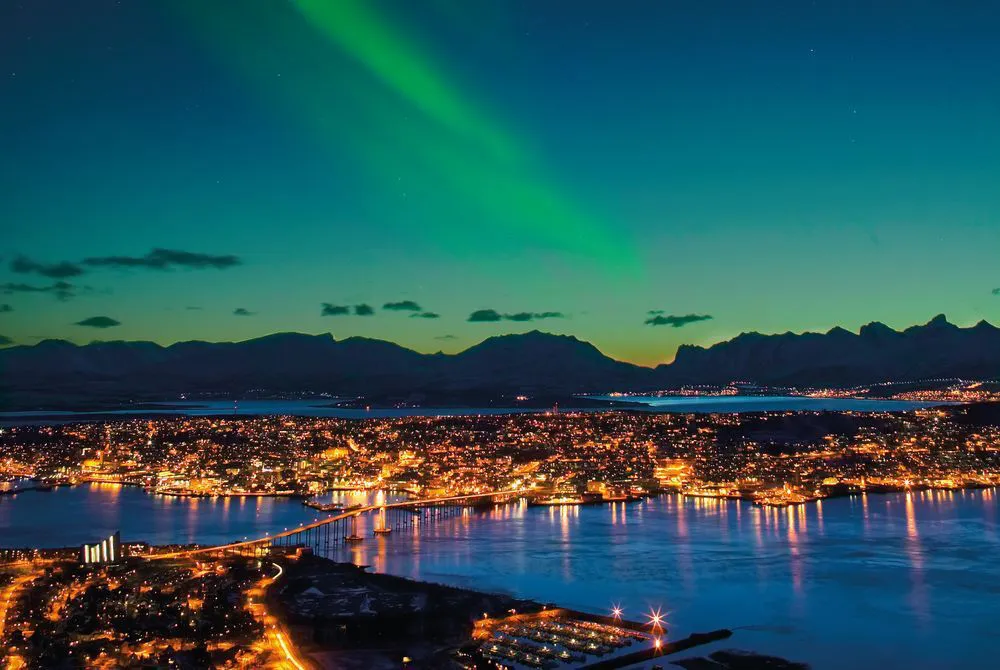
The Sun constantly emits a stream of protons and electrons into space. This is what we call the solar wind, and it travels at an average speed of an average of 350 km per second. Sometimes eruptions occur on the Sun, releasing even more and even faster particles. These particles come from the outermost and hottest part of the Sun's atmosphere, called the corona. Occasionally, magnetic disturbances create holes in the corona, and particles stream out through the gaps.
There are two main types of solar eruptions. One is the Coronal Mass Ejection (CME), which is a giant cloud of plasma hurled out from the Sun's atmosphere at thousands of kilometres per second. The other is a solar flare, which occurs when energy stored in complex parts of the Sun's magnetic field is suddenly released, typically emitting large amounts of X-ray radiation.
Both types of eruption can also generate what are called solar energetic particles. These are the fastest particles, and the most energetic ones can travel at up to 80% of the speed of light, arriving at Earth within minutes of an eruption. When a wave of solar particles reaches Earth, it can weaken our magnetic field, disrupt the electronics in our satellites, and treat us to spectacular auroras.

A solar eruption captured by NASA's Solar Dynamics Observatory (SDO). (Credit: NASA/SDO)
Where can you see the auroras?
When the particles arrive at Earth, they are first met by Earth's magnetic field and travel along it towards the magnetic poles. The closer you are to the poles, the greater the chance of seeing the auroras.
There are always auroras around the north and south poles, but when large numbers of particles arrive from the Sun or there are very powerful disturbances in Earth's magnetic field, the auroras can extend further towards the equator.
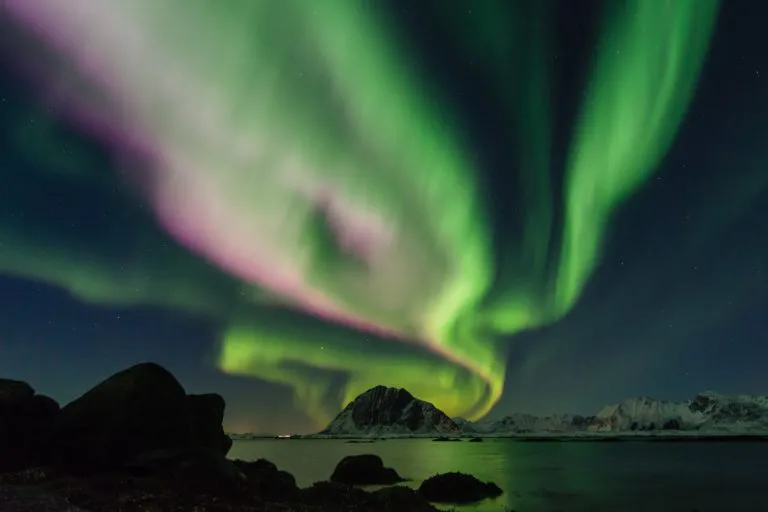
Close to the poles, the auroras appear as large rippling curtains, while further from the polar regions they can appear as rays, because the magnetic field is different there. The light can move quickly across the sky or appear to stand still and pulse. In Denmark, the auroras are often seen only as a very faintly glowing diffuse cloud on the horizon.
Observation tips
There are a number of things to be aware of when looking for the auroras.
- The space weather forecast to find out how active the Sun is and has been
- The general weather forecast to find out if there is a clear view of the sky
- Your physical and geographical location
- In addition, it usually requires warm clothes and a lot of patience
DTU Space has a great overview of what they call space weather. Here you can see the probability of solar flares and computer simulations of the last major solar flare. You can also see a current image of what is called the auroral oval. This is the area in the atmosphere where the auroras are present.
As is always the case when looking at the night sky, it's important to find a dark place away from the city lights. When looking for auroras, north-facing coasts can be a good starting point. You're usually far away from city light pollution and you usually have a good view of the northern horizon.
On the website of the Danish Society for Nature Conservation you can see a list of the darkest places in Denmark.
The best observation opportunities are in the northern part of the country with good views of the northern horizon.
Northern lights in Denmark
Denmark is very southern when it comes to Northern Lights, but you may be lucky enough to catch a glimpse of the coloured waves in the sky.
Links about aurora
The space weather forecast from both DTU Space and the US National Oceanic and Atmospheric Administration, NOAA.
DTU Space Weather
NOAA Space Weather
SpaceWeatherLive
THE NIGHT SKY IN GENERAL
See when the International Space Station can be seen from Denmark.
spotthestation.nasa.gov
The programme Stellarium can be used online or downloaded for free to see what the starry sky looks like at different times and from locations all over the world.
stellarium.org
The best auroras images from the Insight Investment Astronomy Photographer of the Year 2019 competition in the category Aurora.
rmg.co.uk
APPS FOR THE NIGHT SKY
Google Skymap - helps navigate the starry sky.
play.google.com
StarWalk - use your phone to see which constellations and stars you are looking at.
IOS
ANDROID
Aurora Forecast - here you can see which places in Scandinavia have the best chance of seeing the Northern Lights.
IOS
ANDROID
Aurora Now - shows the Sun's activity and the probability of Northern Lights in your area.
IOS
ANDROID