Black holes
Invisible yet so powerful to shape entire galaxies. Black holes come in many sizes, from the remnants of dying stars to giants billions of times the mass of the Sun lurking at the heart of almost every galaxy. They are places where gravity is so overwhelming that even light cannot escape. Welcome to the world of black holes!
Why do we call them black holes?
Black holes were predicted mathematically long before we first observed them. Einstein's general theory of relativity describes how all objects with gravity will bend the space around them. You can imagine it a little like placing a heavy ball on a trampoline. The ball sinks into the surface, creating a dip that pulls everything around it inward. Gravity works the same way, with massive objects creating a dip in the fabric of space that pulls everything around them inward too.
The concept of bending space might sound like it came straight out of a science fiction novel, but as strange and unintuitive as it sounds it is a real phenomenon! Let’s try to understand it further.
Going back to the trampoline analogy: small, light balls (such as planets and moons) will only bend the trampoline a little, while heavy balls (such as large stars and galaxies) will bend it more. The heavier the ball, the more the trampoline, or space in our case, bends.
According to Einstein's theory, a ball can become so heavy and so small that the hole it creates in the trampoline becomes so extraordinarily deep that nothing that falls into the hole will ever be able to get back out, not even light! This statement becomes even more remarkable remembering that light is the fastest thing we know of in the universe. That is exactly what a black hole is! An incredibly heavy, infinitely small point that bends spacetime so much that nothing can escape it. And that is also where the name comes from: the curvature is so extreme it resembles an infinitely deep “hole”, and “black” because, as we just established, not even light can escape to reveal it."
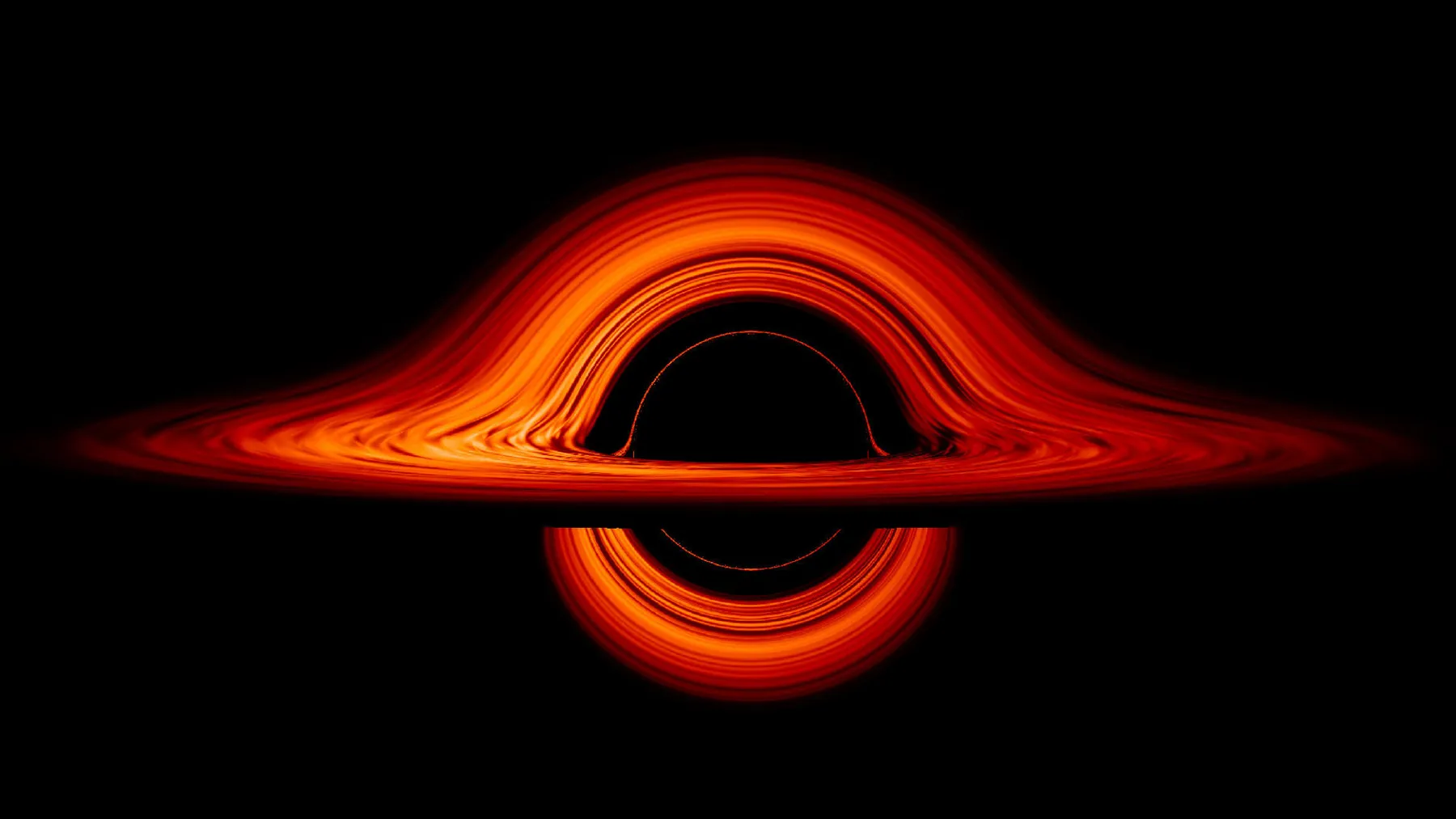
A NASA simulation showing how a black hole's gravity bends light from its surrounding gas disc, warping spacetime itself into a visible shape. (Credit: NASA's Goddard Space Flight Center)
How big can black holes get?
Black holes come in a surprising range of sizes. The ones formed from dying massive stars, as described in our section on Stars, typically have a mass of just a few to a few tens of times the mass of the Sun. In astronomy, the Sun's mass is actually a common unit we use to describe large objects, simply because it gives us a familiar reference point.
But black holes can get much, much larger than that. At the centres of galaxies, including our very own Milky Way, we find what are called supermassive black holes, with masses ranging from millions to billions of times the mass of the Sun. How these giants form is still an open and fascinating question in astronomy. They cannot simply be the remnants of single dying stars, so where do they come from? Scientists are still working on the answer, and it is one of the biggest unsolved mysteries in modern astrophysics. You can read more about our own galaxy's black hole Sagittarius A* in the section on Galaxies.
The brightest objects in the universe
Despite the darkness we associate with black holes, they are paradoxically also responsible for creating some of the brightest phenomena in the universe! This happens when enormous amounts of gas and dust swirl around a black hole in what is called an accretion disk, spiralling inward at tremendous speeds. As this material falls toward the black hole, it is compressed and heated to millions of degrees, causing it to glow with extraordinary intensity.
When this happens with the supermassive black holes sitting at the centres of distant galaxies, we call it a quasar, a name with an interesting history. When astronomers first observed these extraordinarily bright objects, they were puzzled. They were far too luminous to be ordinary stars, and yet they appeared as tiny point-like sources of light in the sky, just like stars do. Not quite a star, but not quite anything else they had seen before. They ended up calling them quasi-stellar objects, meaning "almost star-like," which was eventually shortened to quasar. It was only later, as our telescopes improved, that we understood what we were actually looking at: the brilliantly lit feeding grounds of the most massive black holes in the universe! A quasar can shine so brilliantly that it outshines every single star in its host galaxy combined, making it visible across billions of light years of space. In fact, some of the most distant objects we have ever observed in the universe are quasars. So in a strange and wonderful twist, the darkest objects in the universe are also responsible for some of its greatest light shows.
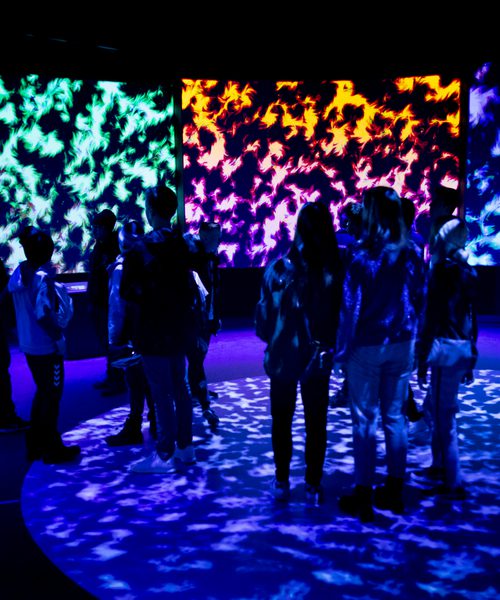
In the image below you can see how a black hole causes the dust and gas around it to glow, and how that light is bent by the black hole's immense gravity. One of the best illustrations of a black hole can actually be found right here at the Planetarium, in our KOSMOS exhibition! Come and visit us and see for yourself.

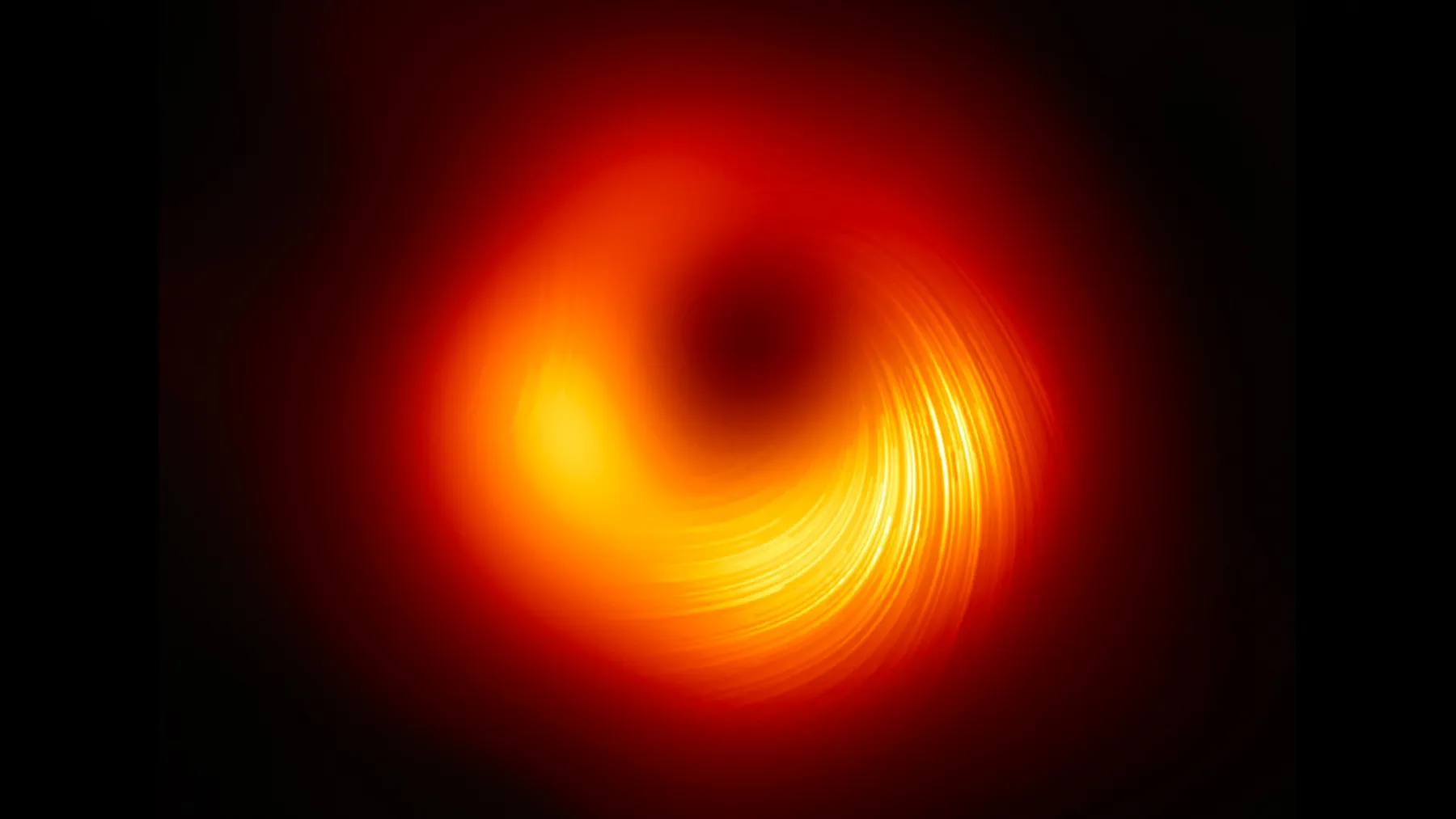
Image taken by the Event Horizon Telescope of the supermassive black hole (Sagittarius A*) at the center of our very own galaxy, the Milky Way.
Electromagnetic observations
Black holes are very difficult to observe, as the rest of the universe is also rather dark, and it is therefore hard to spot a black hole against a black background. However, even when we cannot see a black hole directly, we can often observe it indirectly by looking at the effect it has on its surroundings, and that effect is dramatic.
Among other things, we can see the light from material that the black hole is in the process of consuming. This might come from a star or nebula that has strayed too close to a black hole. The star or nebula will be torn apart, and the dust and gas are pulled toward the black hole, forming a disk of extremely hot material that eventually disappears into the black hole. The light comes from this material heating up so intensely on its way that it begins to glow.
We can also look at how the black hole affects the very fabric of space around it. As described earlier, a black hole bends space dramatically, and when this happens, space can act a little like the lens of a magnifying glass, amplifying and distorting the light that passes behind it.
Occasionally, however, we can be fortunate enough to observe a black hole directly, as has been achieved by the Event Horizon Telescope project. The Event Horizon Telescope represents the first time in history that the event horizon of a supermassive black hole has been directly observed. To make this possible, scientists built a virtual telescope the size of the Earth by combining the power of radio telescopes from around the world, an astonishing feat of global scientific collaboration.
Since the first image of a black hole was captured in 2019, the Event Horizon Telescope has continued to push the boundaries of what is possible. In 2022 it released the first image of Sagittarius A*, the supermassive black hole at the heart of our own Milky Way. In 2024, a new image of Sagittarius A* revealed for the first time the powerful magnetic fields spiralling around it. And in 2025, new observations M87* (the black hole at the center of the M87 galaxy) produced unexpected results that are already challenging our existing models of black hole physics.
Nonetheless, telescopes are not the only way we have learned to detect black holes, as in the past decade an entirely new window onto the universe has opened up with the detection of gravitational waves.

A black hole acting as a gravitational lens, bending and distorting the light of a galaxy behind it, a direct consequence of spacetime being warped by extreme gravity. (Illustration: ESA/NASA)
Gravitational waves
When massive objects like black holes or neutron stars spiral toward each other and merge, they send ripples through spacetime (more on this in the following section), travelling at the speed of light. These ripples are called gravitational waves. In principle, any object with mass produces them, even you standing here reading this. However, the waves produced by everyday objects are so vanishingly small that they are completely undetectable. Only the most violent events in the universe, such as two black holes colliding, produce gravitational waves strong enough for us to measure.
Even in that case, their detection is extremely difficult. By the time a gravitational wave from a distant black hole merger reaches Earth, it stretches and compresses space by less than a thousandth of the width of a single proton! To detect something so small, scientists built a new type of observatory called an interferometer. An interferometer works by splitting a laser beam into two beams and sending them down two long tunnels at right angles to each other, several kilometres long (check out Telescopes and observatories to see how it looks like). The beams bounce off mirrors at the end of each tunnel and return to the start, where they recombine. If a gravitational wave passes through, it stretches one tunnel and squeezes the other by a tiny amount, causing the returning beams to arrive at slightly different times. This incredibly tiny difference is what is measured by the detector.
In 2015, the LIGO detectors in the United States made the first ever detection of gravitational waves, from two black holes merging over a billion light years away. The signal lasted less than a second but was one of the most significant scientific discoveries of the century. Since then, a global network of interferometers has been built up, including Virgo in Italy and KAGRA in Japan, collectively known as the LVK collaboration. Together they have detected over a hundred gravitational wave events, from colliding black holes to merging neutron stars, with each event revealing something new about the most extreme objects in the universe.
The European Space Agengy is currently developing LISA, the Laser Interferometer Space Antenna, planned for launch in 2035. LISA will consist of three spacecrafts flying in a triangular formation millions of kilometres apart, connected by laser beams. This enormous baseline will make it sensitive to much lower frequency gravitational waves than ground-based detectors can reach, allowing it to detect the mergers of supermassive black holes at the centres of distant galaxies, events so powerful they will be visible across the entire observable universe. Where LIGO hears the final moments of stellar-mass black hole collisions, LISA will hear the slow, deep rumble of giants.
The mystery of black holes
So far we have talked about black holes bending space, but Einstein's theory of relativity tells us something even stranger: space and time are not separate things. They are woven together into a single fabric called spacetime, which has four dimensions, the three dimensions of space (forwards and backwards, side to side, and up and down), plus time as a fourth dimension. This means that when a black hole bends space, it also bends time. As you approach a black hole, time passes more slowly, because spacetime is bent powerfully by the black hole's gravity. As you enter the black hole completely, time comes to a standstill. Not for the person inside, but for everyone observing the black hole from the outside!
Perhaps the most mysterious aspect of black holes is the singularity, found at the heart of a black hole. The singularity is the infinitely small point that makes up the black hole itself. Here, none of the laws of physics can describe what happens, not even the theory of relativity. At the centre of a black hole, gravity and density are infinite. In theory, an object caught by a black hole's gravity will be compressed into a single point when it gets too close. The gravity of a black hole is so strong that the speed required to escape it exceeds the speed of light. The boundary beyond which light can no longer escape the black hole's gravitational pull is called the event horizon. When we look at a black hole, it is the event horizon we see, because that is where it turns black. But the actual black hole is a tiny point sitting at the centre.
If we imagine an astronaut inside a black hole trying to send signals out, it would not be possible for us to receive them, because information cannot escape either. Or can it? This question, known as the black hole information paradox, is one of the deepest unsolved problems in modern physics, and scientists are still working on it today.
There is still a great deal we do not know about black holes, how they form, how many there are, how different they can be, and what happens inside them. It is a wonderful mystery, just waiting to be solved by the researchers of the future