The Solar System
Take a journey around our solar system
4.6 billion years ago in our galaxy, the Milky Way, a small part of a gigantic cloud of dust and gas collapsed. Here were molecules and atoms that later became the building blocks of stars, planets and all the life we have here on Earth, including us humans. It was at the centre of such a cloud of atoms and molecules that the Sun was created. The elements were pulled together by gravity and the matter falling towards the centre of the cloud became so hot that hydrogen could fuse and become helium.
Further away from the Sun, where the temperatures were lower, the planets were formed. In our solar system we have eight planets: Mercury, Venus, Earth, Mars, Jupiter, Saturn, Uranus and Neptune. Pluto, once considered a planet, is now categorised as one of the five dwarf planets in the Solar System. In addition to the Sun, planets and dwarf planets, our solar system also consists of moons, comets and asteroids.
The Sun
All planets in the solar system orbit our own star, the Sun.
The Sun - the star at the centre of our solar system - is located in one of the arms of the Milky Way and makes up 99.8% of the solar system's mass. The planets make up only 0.2% of the mass of our solar system. Although the Sun is a so-called ‘yellow dwarf star’, our solar system's star is among the top 5% of the largest stars in the Milky Way and is 333,000 times the size of Earth.
Like all stars, the Sun is a ball of glowing gases. These are mainly hydrogen and helium. In the 15 million degree hot and violent environment of the Sun's core, hundreds of millions of tonnes of hydrogen nuclei turn into helium every second. This is how the Sun produces energy. On average, it takes hundreds of thousands or even millions of years for the energy to reach the Sun's surface.
The Sun radiates energy in all wavelengths of the electromagnetic spectrum - both the light we can see, but also UV, infrared, radio and gamma radiation that we humans cannot see. However, we can see the Sun in different wavelengths with a variety of telescopes that are sensitive to different parts of the electromagnetic spectrum.
When Galileo Galilei pointed his telescope at the Sun, he discovered sunspots - areas of the visible surface that are about 2000 degrees colder than the rest of the surface. The sunspots look like dark areas on the solar disc, but they only look dark because they are colder than their surroundings. The Sun is a key driver of the Earth's environment and the most important condition for life on our planet. Therefore, the study of the Sun is an important branch of astronomy and can, for example, give us more knowledge about the rich activity in the Sun's atmosphere, where millions of tonnes of material are regularly ejected in solar explosions.

Mercury
Mercury is the closest planet to the Sun with an average distance of approximately 58 million kilometres.
Mercury is the smallest of the planets in our solar system - it's not much bigger than the Moon! The ancient Greeks believed that Mercury was two planets. When Mercury was east of the Sun, they called the planet ‘Apollo’, and when it was west of the Sun, they called it ‘Hermes’. However, the Greek philosopher and mathematician Pythagoras discovered that there was only one planet. Today, science faces many challenges in learning more about Mercury. Mercury is difficult to see from Earth, and the Hubble Space Telescope, which is in orbit around Earth, cannot look directly at Mercury because the Sun's heat and light will damage the precious telescope.
However, NASA has launched missions to learn more about the innermost planet of our solar system. The Mariner 10 spacecraft passed the planet three times in the mid-1970s, and the Messenger spacecraft flew past Mercury three times from 2008-2009, and in 2011 was put into orbit around the planet. Messenger crashed on Mercury in 2015 after the spacecraft ran out of fuel. Mercury is named after the Roman god, which is similar to the Greek Hermes. Just as the winged messenger of the gods moved quickly, Mercury's orbit around the Sun lasts only 88 days - twice as fast as Mercury's 176 Earth days. Mercury has almost no atmosphere, and among the planets of the Solar System, Mercury is the planet with the largest temperature fluctuations - from a whopping 430℃ during Mercury's day to -183℃ during Mercury's long night.

Venus
Venus is named after the Roman goddess of love and has a surface temperature of around 480℃.
The warm temperature of Venus is due to the fact that Venus' atmosphere consists almost entirely of CO2, which is a greenhouse gas. This means that the heat is kept within the atmosphere just like in a greenhouse. The dense cloud layer around Venus consists of concentrated sulphuric acid and it also rains with sulphuric acid, but because Venus is so hot, the rain never reaches the planet's surface.
Planets do not shine by themselves, but they reflect light from the Sun. Venus is the brightest planet in our solar system because its cloud layer reflects the Sun's light. It shines so brightly that it has led to a number of misunderstandings throughout history.
During World War 2. During World War II, fighter pilots sometimes fired shots at Venus because they thought it was an enemy aircraft, and Venus' bright light has given rise to many rumours about UFOs. While the surface of Venus cannot be seen directly because the planet is covered by a thick layer of clouds, from 1990-1994 NASA's Magellan spacecraft captured images of what was hiding behind the clouds using radar technology. The images revealed a barren, flat rocky landscape, occasionally covered by mountains, valleys and extinct volcanoes.
Venus is our closest neighbour in the Solar System, and you can find several similarities between Venus and Earth. The two planets are almost the same size and there is only a 2% difference in the material they are made of.

Earth
Our own planet Earth is the third in line of planets from the Sun.
Earth's distance from the Sun, its gravity, and Earth's atmosphere all contribute to creating the conditions for liquid water. Approximately 2/3 of the Earth's surface is covered by water, which was essential for life on Earth to emerge. Earth is still the only planet where we know for sure that life exists. How and when life on Earth originated is still hotly debated. Life on Earth is about 4 billion years old, while Homo sapiens emerged about 200,000 years ago - human evolution is therefore only a very small part of Earth's history.
Earth's appearance has changed a lot since the planet was formed around 4.6 billion years ago. The lithosphere, Earth's crust and the upper part of the mantle, is divided into a series of plates that have collided, pushed apart, and scraped up and down against each other throughout Earth's history. The tectonic plates only move a few centimetres a year, but it has been enough for the Earth's continents to form one supercontinent several times. The last time this happened was around 200 million years ago, when our planet was dominated by the supercontinent Pangaea.
Below the crust is the Earth's mantle - the largest part of the Earth's interior, which consists mainly of solid rock, yet has a gritty, semi-liquid consistency. At the very centre of our planet is a core of nickel and iron that is as hot as the surface of the Sun, but because the pressure is so high, the innermost part of the core cannot melt. However, the inner part of the core spins around in a liquid outer core, and it is the currents in the outer core that, together with the Earth's rotation, cause the Earth's magnetic field. It is not possible to drill down to the Earth's core, but we know about the Earth's internal structure from measurements of seismic movements inside the Earth. Seismic measurements are taken, for example, when an earthquake occurs. Waves travel through the Earth, and these waves behave differently depending on what material and where in the Earth's interior they are located.

The Moon
The Moon's landscape is barren and covered in craters caused by meteor impacts.
Most of the craters date from early in the Moon's history, from the period known as the Late Heavy Bombardment, approximately 4.1-3.8 billion years ago. Because the Moon has no atmosphere, the meteors meet no resistance until they collide with the lunar surface and there is no wind and weather to erase the craters. Large meteor impacts happen much more rarely today. One of these craters, Tycho, is named after the Danish astronomer Tycho Brahe. Although the Moon's gravity is only 1/6 of the Earth's, both the Moon's and Earth's shape changes slightly due to each other's gravity. The tides here on Earth are a result of the attraction of the Moon.
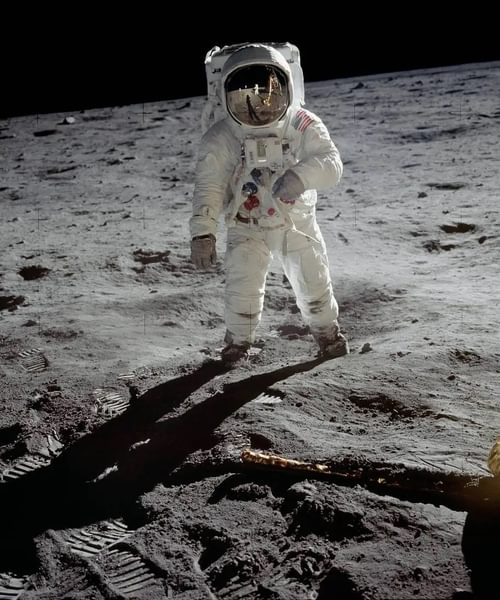
Satellites are not just man-made constructions that can help us observe and collect data, watch TV and listen to the radio, or communicate. A satellite is defined as something that orbits a celestial body. The moon orbits the Earth and we call it a natural satellite. Our moon is one of over 170 known moons in the Solar System. From Earth, we always see the Moon from the same side. It has what is called a bound rotation. During the six Apollo landings from 1969-1972, astronauts collected large amounts of data about the Moon.

Livet på Jorden ændrede dens atmosfære. Her ser vi en illustration af atmosfæren før der kom liv (til venstre) og hvordan den ser ud nu (til højre).
Hvis fjerne rumvæsner kiggede på Jordens atmosfære, ville de se, at det luft der er mest af er kvælstof, og det luft der er næstmest af er ilt. Hvis Jorden ikke havde noget liv, ville der ikke være ilt overhovedet, så rumvæsnerne ville straks kunne se at der er noget galt, og at der må være liv der lukker ilt ud i atmosfæren.
Vores forskere prøver at gøre det samme med exoplaneter, og selvom de ikke har fundet sikre tegn på liv endnu, har de allerede fundet flere planetsystemer, der er spændende: såsom TRAPPIST 1 systemet der har hele syv planeter på størrelse med Jorden, hvoraf flere ligger i den beboelige zone, og K2-18b der har både en atmosfære, flydende vand, og spændende kemi.
Intelligent liv
Det er uvist hvor mange forskellige former for liv der har boet på jorden, men forskerne er kommet frem til alt mellem to millioner og fem billioner forskellige arter. Hvad vi ved med sikkerhed er, at kun ÉN af dem udviklede teknologisk intelligens. Kun én art begyndte at observere verdensrummet med teleskoper og byggede rumraketter. Én teknologisk art er virkelig ikke særlig mange, hvis der har været fem billioner forskellige arter på Jorden.
Dette er grunden til, at vi ikke regner med, at det meste liv i rummet ligner os. Fordi ikke engang det meste liv på Jorden ligner os, og vi er endda i familie.
Vi håber dog stadig på, at der kunne findes rumvæsner, der har udviklet sig lidt på samme måde som os, og som også har opfundet teknologi, for det ville betyde at vi måske kan kommunikere med dem. Derfor startede vi SETI-projektet, der står for “Search for Extra-Terrestrial Intelligence”, eller “Søgen Efter Udenjordisk Intelligens”.
SETI lytter ud i rummet efter signaler fra intelligent liv, der prøver at tale med os. De lytter mere eller mindre efter lyden af teknologi, og især efter såkaldte radiobølger, som også er dem, vi bruger i vores radioer, telefoner, og fjernsyn. Det er fordi vi har fundet ud af, at radiobølger ser ud til at være de mest effektive signaler at sende igennem rummet, og vi regner med at intelligente rumvæsner vil komme frem til samme opdagelse, og derfor også vil vælge radiobølger at kommunikere med.
Vi har endnu ikke modtaget noget signal, og om det er fordi der ikke er andre livsformer med teknologisk intelligens, eller fordi vi bare ikke har fundet dem, er svært at sige.
Men vi her på Planetarium tror at det er vigtigt at huske på, at der er ufatteligt mange forskellige måder at udvikle sig på og mange forskellige former for intelligens. Vi mennesker har lidt en tendens til at sætte os selv op på en piedestal, og det kan være svært for os at acceptere, at vi bare er én ud af mange livsformer på Jorden, der alle sammen excellerer med hver sin overlevelsesstrategi.
Så selv hvis det liv vi finder i rummet ikke ligner eller tænker som os, og selv hvis det ikke bruger teknologi som vi gør, bør det stadig mødes med den største respekt og nysgerrighed, og hvor ville det dog være fantastisk endelig at møde dem vi deler universet med.