Mission to Mars
Decades of missions have brought Mars closer than ever, and the next frontier is no longer robotic rovers but human footprints.
The red planet has long been the subject of human curiosity! Here we tell you more about the many missions to Mars, the journey of robots down to the surface, and the plans for future crewed missions.
Humans are curious by nature, and Mars is one of the most exciting and accessible places where we search for answers to our many questions. The question of whether there is life beyond Earth is particularly compelling to investigate on the red planet.
Mars resembles Earth in many ways, both in its size (slightly smaller than Earth), composition (formed from the same materials), and distance from the Sun (lying 50% further away). There are however also significant differences.

Illustration of what Mars might have looked like when its surface was covered in oceans. (Illustration: NASA)
Because Mars is smaller than Earth, its core is not as hot, and because it lies further from the Sun, it also receives less warmth from our star. The surface of Mars is therefore frozen, and temperatures can drop as low as -140 degrees at night.
Part of Mars' atmosphere has also frozen onto the surface, just as water from Earth's atmosphere can settle as snow and ice on our surface. Mars' atmosphere is now very thin, and at the surface it is 100 times thinner than the one on Earth. The small amount of atmosphere that remains consists mainly of carbon dioxide.
However, it might not have always been this way. Scientists claim that Mars was once warmer, with a thicker atmosphere. There is also evidence that liquid water once flowed across its surface. Researchers have in fact found signs that there were once rivers, lakes, and oceans on Mars, and that roughly half the planet was probably covered by oceans around three billion years ago.
As you can read in our Life in Space section, liquid water is particularly exciting because it is one of the most important factors in determining whether life can exist on a planet. Several missions have therefore been sent to search for signs of life, both current life and signs that life may have existed in the past. Liquid water is also important for another reason: we humans need it too. This makes its presence on Mars particularly relevant for the planning of future crewed missions, and another key task for the Mars missions has been to run experiments to prepare us for eventually sending humans to the red planet.
The early missions
The first successful mission to Mars was the American Mariner 4 mission in 1964, which succeeded after the Soviet Union had launched five other missions that unfortunately all failed. Mariner 4 flew past Mars and sent 21 images back to Earth. A number of missions from both NASA and the Soviet Union followed, flying past the red planet and delivering images and other data back to Earth.
In 1971, the first human-made object landed on the surface of Mars: the Soviet lander Mars 3. Mars 3 was supposed to deploy a small rover onto the surface, but lost signal after just 110 seconds, leaving us with only a single image from the mission.
In 1976, NASA landed two Viking landers, Viking 1 and Viking 2. These landed safely and operated for several years, sending back images and taking measurements of the planet's atmosphere and surface. Among these were measurements of the composition of Martian dust, in an attempt to search for life. The measurements initially seemed promising, but it has since been concluded that what the missions found was most likely not life.
In 1997, NASA landed the first rover on the surface of Mars: the Sojourner rover from the Mars Pathfinder mission, which set out to study the geology of Mars in more detail.
The year 2003 was finally Europe's turn to explore Mars, with ESA's Mars Express going into orbit around the planet. On board was a lander, Beagle 2, which unfortunately crashed. However, the Mars Express orbiter has been very successful and continues to this day to send images and measurements back to Earth.
Sending missions to another planet is difficult and things do not always go to plan. Thankfully when they succeed, they tend to have long lifespans, often surviving far longer than expected. This proved fortunate, as it was instruments aboard a ten-year-old spacecraft that first revealed that liquid water still exists on Mars today. This discovery was made by the Mars Reconnaissance Orbiter in 2015 and has since been confirmed by several other missions. The liquid water unfortunately only exists in very small quantities, nothing like the oceans and lakes that once covered the planet, but it remains very exciting for the search for life on Mars.

Each hole tells a story. This mosaic shows drill samples taken by the Curiosity rover at different locations across Mars, revealing the remarkable variety of rocks and minerals beneath the planet's surface. (Credit: NASA/JPL-Caltech)
Science on wheels
The most famous Mars missions are probably those involving rovers, robotic vehicles that can drive across the surface and examine locations up close, making our measurements far more precise than observations taken from a distance.
Among the best known are Spirit and Opportunity, which landed in 2003, and Curiosity, which arrived in 2011 and is still active today. Curiosity's main goal is to determine whether Mars could ever have supported life, and it has already delivered: by examining ancient lake sediments and former groundwater areas, it found that Mars once had all the right chemical ingredients to support microbial life.
One of the most remarkable things about Mars missions is their longevity. They are designed to last months but often survive for years or even decades. The Trace Gas Orbiter, launched in 2016 as part of the ExoMars programme, is still orbiting Mars today, studying whether traces of methane and other gases in the atmosphere could be signs of biological or geological activity. The next step for ExoMars is even more ambitious: the Rosalind Franklin rover, planned for launch in 2028 and landing in 2030, will drill up to two metres into the Martian surface in search of signs of ancient life, something no rover has ever done before.
More recent missions
With the more recent missions, space agencies are taking their exploration of the red planet into the next generation. Of particular interest are Mars 2020 from NASA and ESA, and the Tianwen missions from CNSA (China), both of which aim to collect samples to be returned to Earth. This kind of sample return mission is an entirely new form of Mars mission, and will allow us to study the Martian surface in far greater detail, giving us a wealth of new knowledge about the planet's history and the possibility of life.
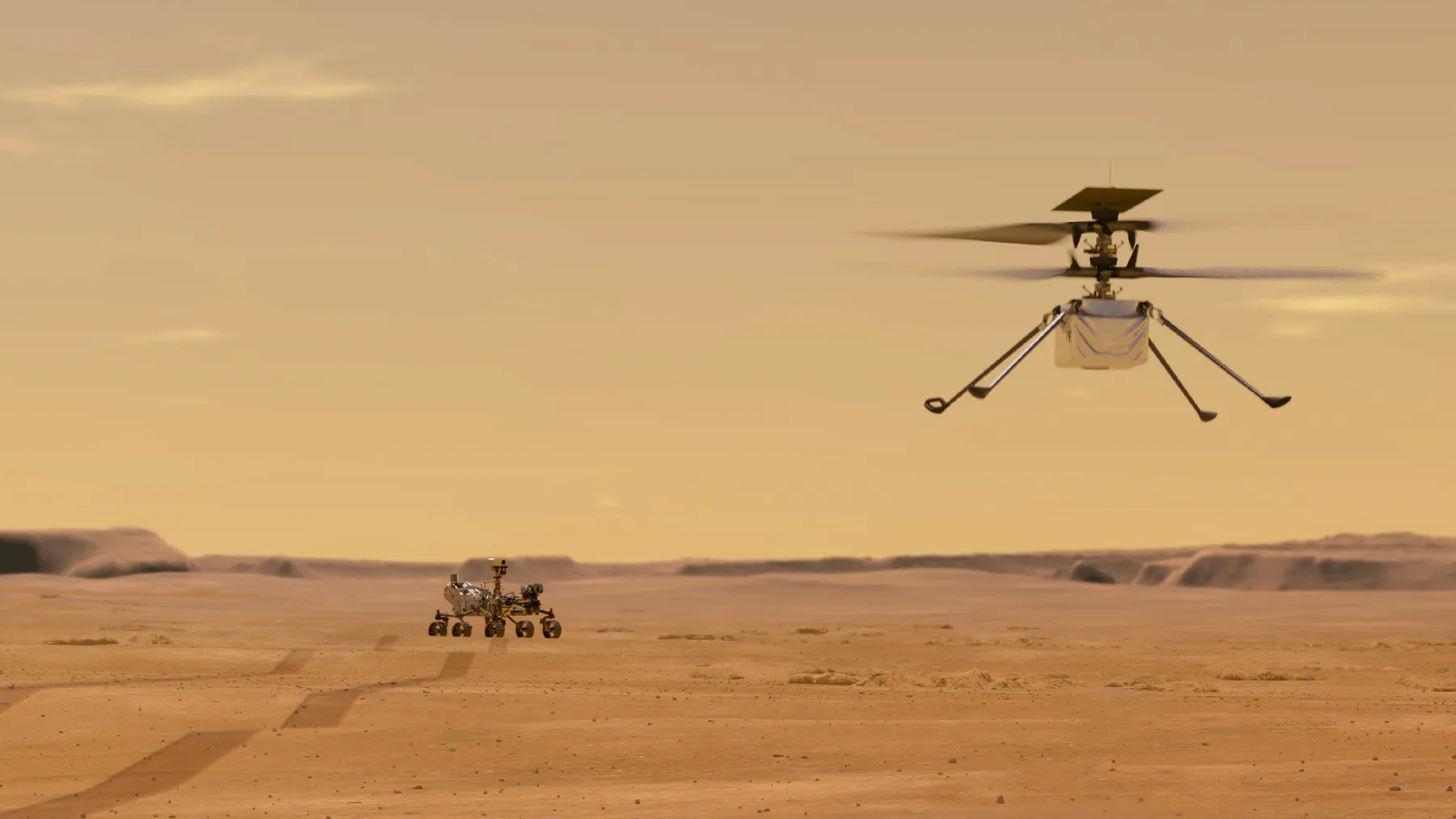
The most recent rover, Perseverance, arrived in 2021 with an ambitious goal: to actively search for direct evidence that ancient life once existed on Mars. In 2024 it made one of its most exciting discoveries yet, a rock nicknamed "Cheyava Falls" covered in a pattern of spots formed by chemical reactions that microbes are known to create in rocks here on Earth. Whether this is truly a sign of ancient life is still being investigated, but it is one of the most promising clues that were ever found. Perseverance also carried the small helicopter Ingenuity, which completed 72 historic flights before going out of service, marking the first time an aircraft had ever flown on another world. Developing a helicopter capable of flying in Mars' thin atmosphere was quite an achievement, and when Ingenuity lifted off in 2021, it marked the first time an aircraft had ever flown on another world! The plan for Perseverance is to collect and store samples for eventual return to Earth. NASA and ESA had developed a joint mission to retrieve them, but this Mars Sample Return (MSR) program was cancelled by the US Congress in early 2026 due to rising costs. The collected samples currently remain on Mars, and their fate is uncertain.
China on the other hand, has kept maintaining and sending ambitious missions to the red planet. The first part of Tianwen missions, Tianwen-1 in addition to an orbiter, a lander, and a rover, also included several separate camera units. Tianwen-1's rover, Zhurong, drove across the Martian surface taking measurements of the soil and ice until it was covered by a dust storm and went into hibernation in 2022. The next planned Tianwen mission, Tianwen-3, is expected to launch in 2028. This mission will land on the planet and collect samples by drilling up to 2 metres into the ground. These samples will be sent back to Earth, where they are expected to arrive in 2031.

Perseverance takes a selfie on the surface of Mars, surrounded by the rocky terrain of Jezero Crater, where it has been searching for signs of ancient microbial life since landing in February 2021. (Credit: NASA/JPL-Caltech)
Humans on Mars
In the future, we hope to take our exploration of Mars to the next level by sending humans to the red planet. This is no small challenge, and several space agencies and private companies are working towards this goal.
The most concrete plans come from established space agencies. NASA has spoken of a crewed mission in the 2030s, though recent budget cuts have cast some uncertainty over this timeline. China's CNSA is targeting 2033, and ESA hopes for a mission around 2040. The most ambitious private player is SpaceX, whose Starship rocket is being developed with Mars explicitly in mind.
Before any of this can happen, there are enormous challenges to overcome. The journey alone takes 7 to 9 months, during which astronauts would be exposed to radiation and the psychological toll of deep isolation. Upon arrival, they would face a hostile environment with unbreathable air, toxic soil, and dust storms capable of covering the entire planet. Because conditions are so dangerous, astronauts would spend almost all their time inside their spacecraft, creating entirely new challenges around loneliness and isolation.

Earth and Mars side by side, shown to scale. Despite sharing several similarities, including comparable day lengths and a tilted axis, Mars is roughly half the size of Earth and has lost the atmosphere and liquid water that once made it more Earth-like. (Credit: NASA/JPL/Malin Space Science Systems)
This is why the International Space Station has been so valuable. For more than 25 years it has served as a laboratory for understanding what extended spaceflight does to the human body, from the effects of weightlessness to the mental challenges of living in a confined space far from Earth. Two astronauts have even spent almost a year aboard the ISS specifically so researchers could study the long-term after-effects. It is also a shining example of what space agencies and nations can achieve when they work together rather than compete. You can read more about the ISS in our section on Spaceflight.
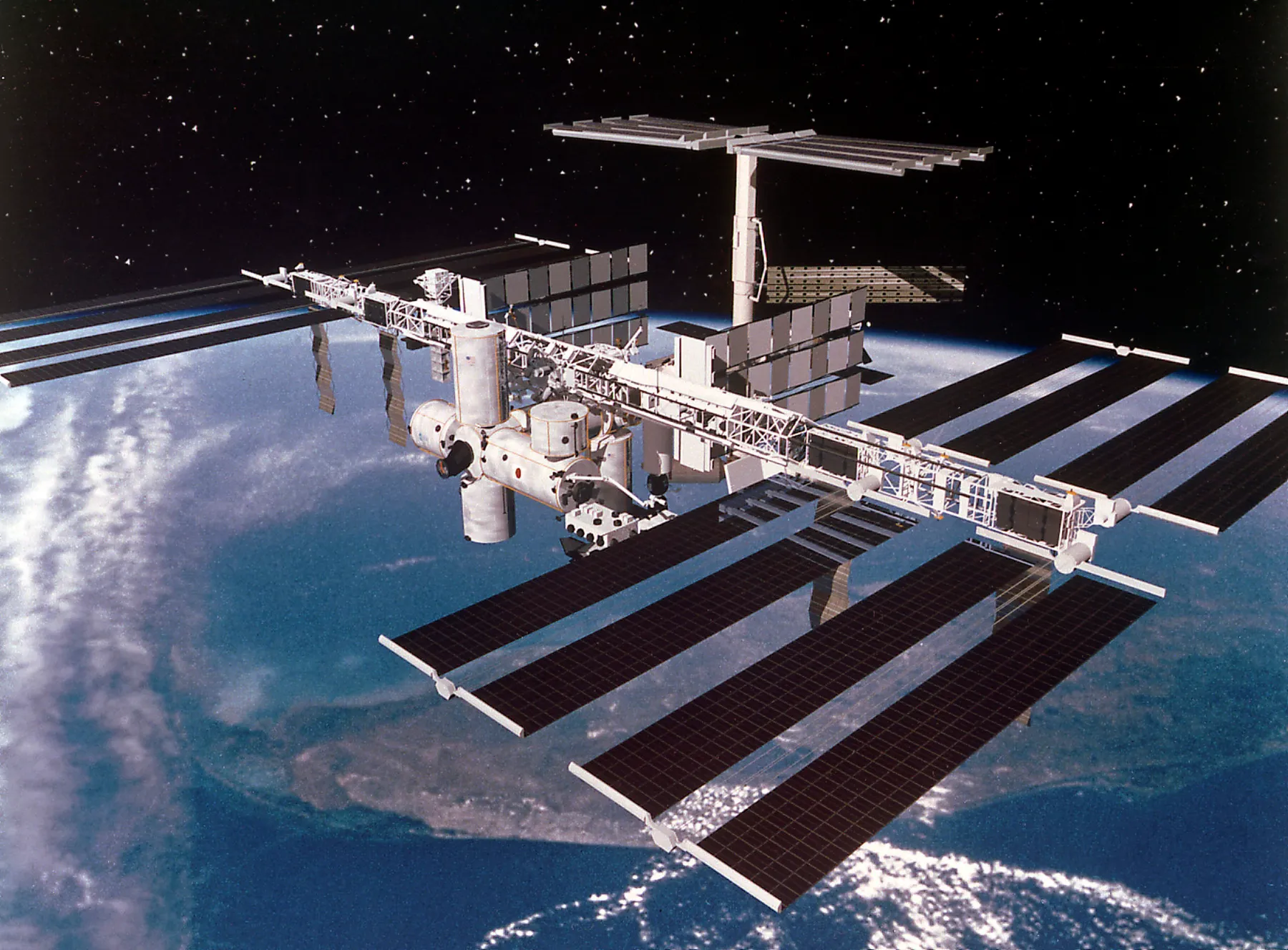
The International Space Station has been orbiting Earth like a giant laboratory since 2000.
There is still some way to go before we are ready to send humans to Mars, but in the meantime our robotic missions will continue to teach us a great deal about our red neighbour, bringing us closer to answering one of humanity's oldest questions: are we alone?