The Big Bang
We take a closer look at the beginning of the universe, the Big Bang, where both time, space, and all the matter in the universe came into existence.
If we look around us today, we see an infinitely large universe built of energy and particles. The energy could for example be all the light we see from stars or our lamps (or the screen you are sitting in front of right now), and the particles could for example be the building blocks of the atoms you yourself are made of. Everything you see around you is built from atoms. Atoms are built from particles: protons, neutrons, and electrons. These particles are built from even smaller elementary particles called quarks.
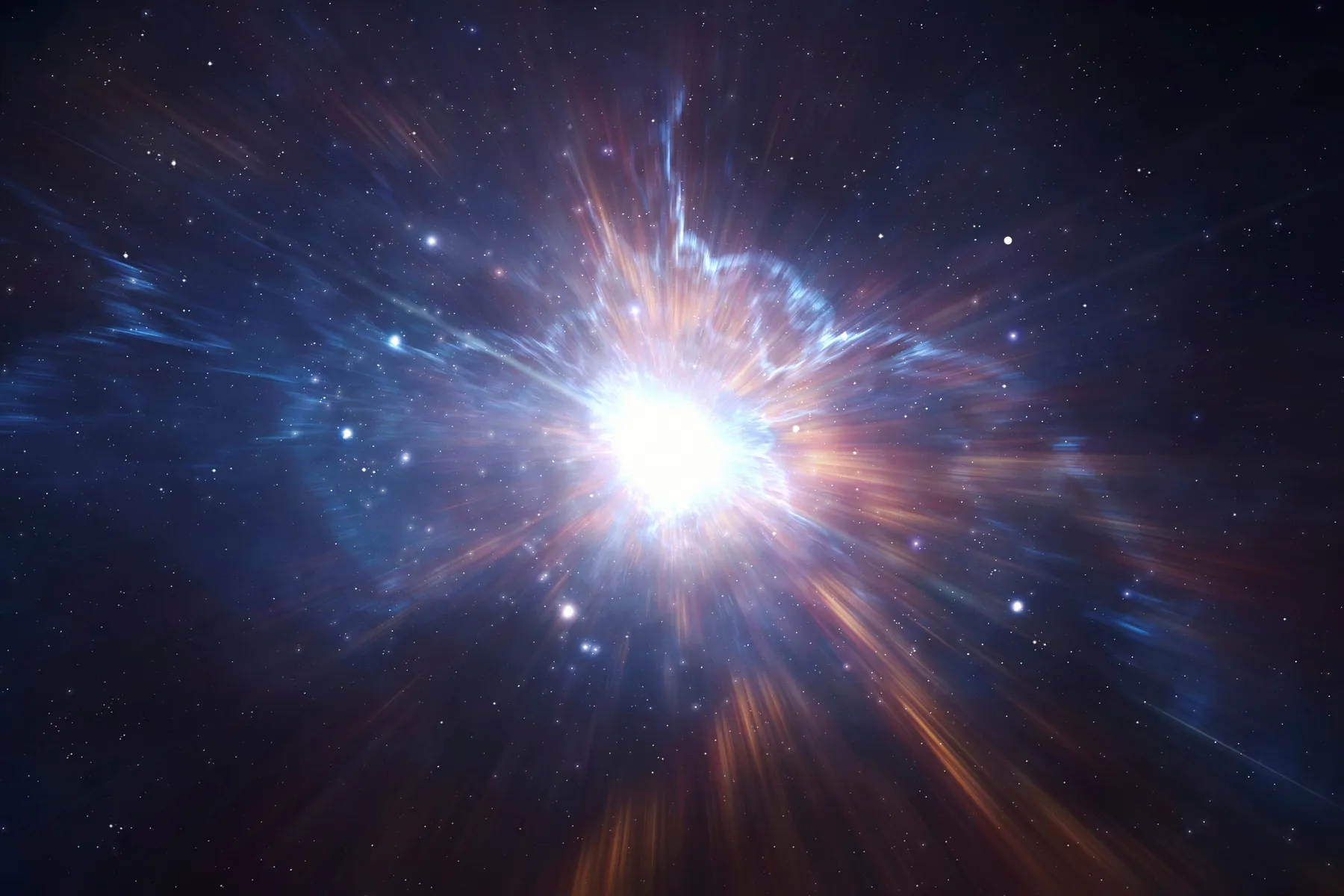
Once, around 13.8 billion years ago, there were no atoms, no particles, and no energy. There was also no space and no time, so it is difficult to argue that there was anything at all. Researchers believe that a tiny imbalance arose in this nothingness. A small shift at the quantum level that set off an enormous chain reaction. From one moment to the next, it went from nothing to an entire universe. But it looked very different from how it looks today.
At the moment the universe was born, it was incomprehensibly small. It occupied only a single point. So if you think about taking the entire universe we have right now and compressing it into a tiny point, you can perhaps imagine that everything would have to be tightly packed together. When things are tightly compressed together they also become hot, and the newborn universe was unimaginably hot, around one hundred quintillion degrees, which is a 1 followed by 32 zeros.
We cannot begin to imagine something so small and so hot, and at that time the entire universe was just a very hot soup of quarks (the elementary particles we mentioned earlier), with none of the things we know today. It is difficult for researchers to truly describe what happened then, because when things become so extremely dense, they are hard to describe using our laws of physics, and we cannot really conduct experiments that replicate the extreme conditions of that time.
What we do know is that the universe began to expand, rapidly and enormously, and with each passing moment something new came into existence. Here is the story of how nothing became everything.

The history of the universe from the Big Bang to today, spanning 13.8 billion years. From left to right: the first split-second of inflation, the formation of the first particles, hydrogen and helium nuclei forming just three minutes in, light being set free after 380,000 years, the first stars igniting after 200 million years, galaxies and dark matter taking shape, dark energy accelerating the expansion, and finally today, a universe full of galaxies observed by curious humans. (Illustration: NASA)
Atoms come into being
Around three minutes after the Big Bang, the universe had expanded so much that it had cooled to just one billion degrees, and quarks could gather into larger particles. The first protons were formed, and with them the first atomic nuclei. In the minutes that followed, all other matter in the universe was formed. The first atomic nuclei to form were hydrogen, helium, and small amounts of lithium.
Hydrogen is the most abundant element in our universe. It is the simplest element, consisting of just a single proton. Hydrogen is important to us as it is part of many chemical compounds, including the water we drink and which is found in the cells of our bodies. All the hydrogen that exists today, including the hydrogen in our bodies, was created here, just a few minutes after the Big Bang.
Light is set free
For the next 300,000 years the universe expands and cools. Atomic nuclei float around in a hot plasma, surrounded by light particles, or photons, bouncing between the particles and interacting with them. After 380,000 years, something suddenly happens. The universe has now expanded and cooled so much that it is only around 3,000 degrees, roughly the same temperature as the surface of the Sun. This allows electrons to bind to atomic nuclei and create the first complete atoms, and when that happens, light is set free!
What does that mean? Until now, light has been bouncing from particle to particle, electron to electron, never getting very far before colliding with another particle. Now that electrons have bound to atoms, there is suddenly space for light to travel freely through the universe. We also say that the universe became transparent at this point.
The first light in the universe was therefore not emitted until 380,000 years after its creation, and some of it has been travelling ever since, for 13.8 billion years, before reaching us. This is what we today call the cosmic microwave background (CMB) radiation. The CMB radiation can be measured in all directions as a kind of faint background noise in the universe. The radiation reaches us as microwaves, a form of light that cannot be seen with the naked eye but can be measured with special instruments.
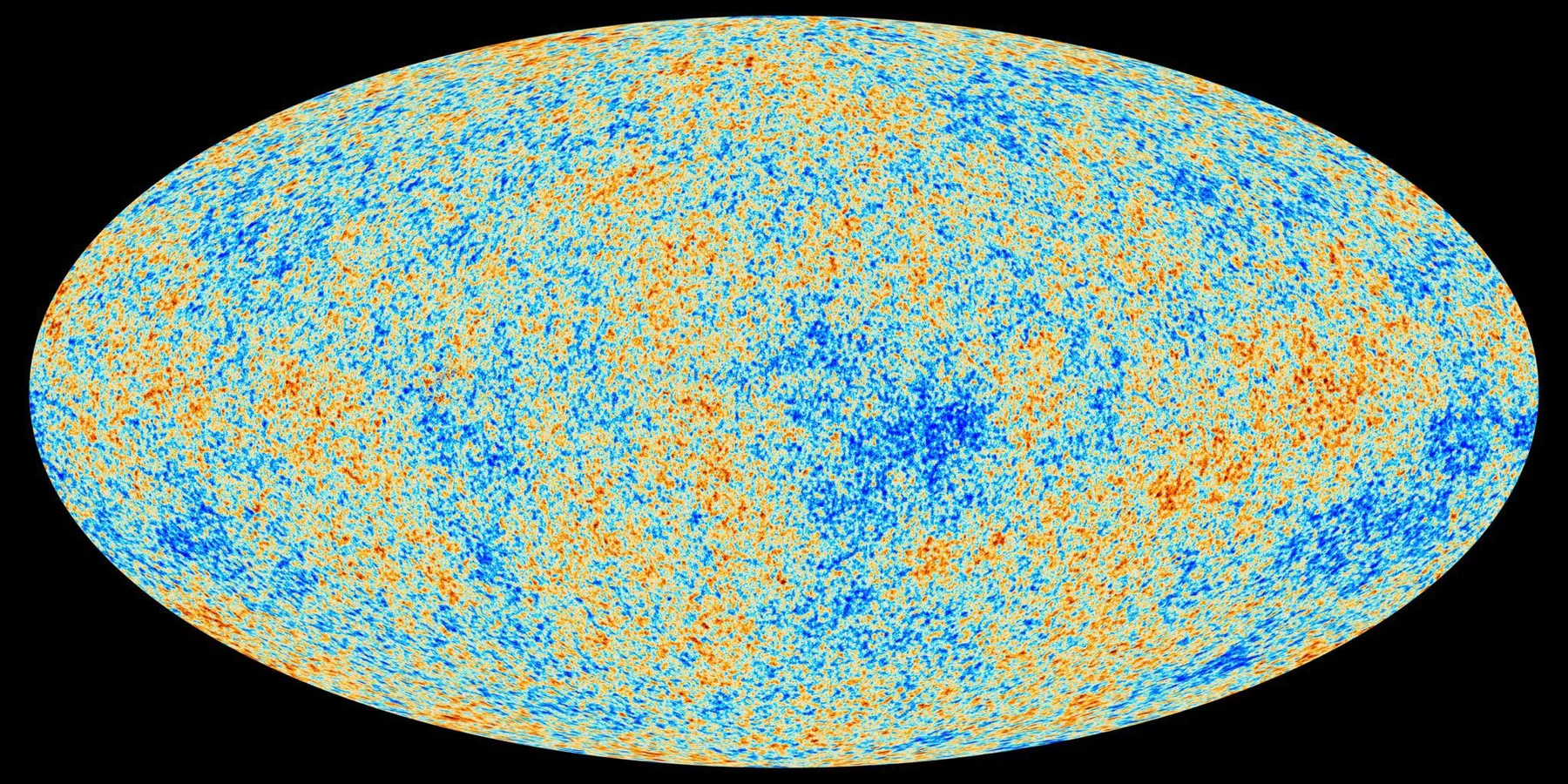
The cosmic microwave background radiation mapped by the Planck mission. This image is a map of the entire sky, where the different colours represent tiny temperature variations in the radiation. (Credit: ESA / Planck Collaboration)
When we observe the universe, it is almost always light that we observe, so the cosmic microwave background radiation is the earliest thing we can observe in the universe. Everything that happened before the cosmic microwave background is something we have calculated rather than something we have seen. But this background radiation can help researchers learn more about both the age and composition of the universe.
The cosmic microwave background radiation is one of the strongest pieces of evidence for the Big Bang. It was discovered by accident in the 1960s, but before that several researchers had calculated that there should be an afterglow from the Big Bang, and what temperature that afterglow should have. The first measurements of the background radiation matched these calculations well, and subsequent observations have only strengthened the theory further.
The expansion of the universe
From the moment light was set free and atoms gathered together, we had everything needed to build the universe as we know it today.
As the universe expanded and cooled, atoms gathered into clouds of gas, and from these the first stars were created. Inside the stars, the first atoms, hydrogen and helium, were converted into larger atoms, which were released when the stars died.
Stars gathered into galaxies, which created structures throughout the universe. The stars were joined by dark matter, which helps hold galaxies together, but which we still do not know the composition of.
In the empty vacuum between galaxies, it is dark energy that reigns, amplifying the expansion of the universe so that it accelerates faster and faster. Around 9 billion years after the Big Bang, a cloud of gas containing atoms from both the Big Bang and the deaths of stars collapsed and created a star we today call the Sun, and a planetary system we today call the Solar System. On one of the Solar System's planets, Earth, some of those atoms came together and created the first cells, and those cells have since evolved into millions of different forms of life.
And today, 13.8 billion years after the Big Bang, it is amazing to think how many things we can learn simply by looking up at the sky, and to think that all the incredible phenomena we see today all arose from a single point.